Yan Shanchun:The Color of Pomegranates
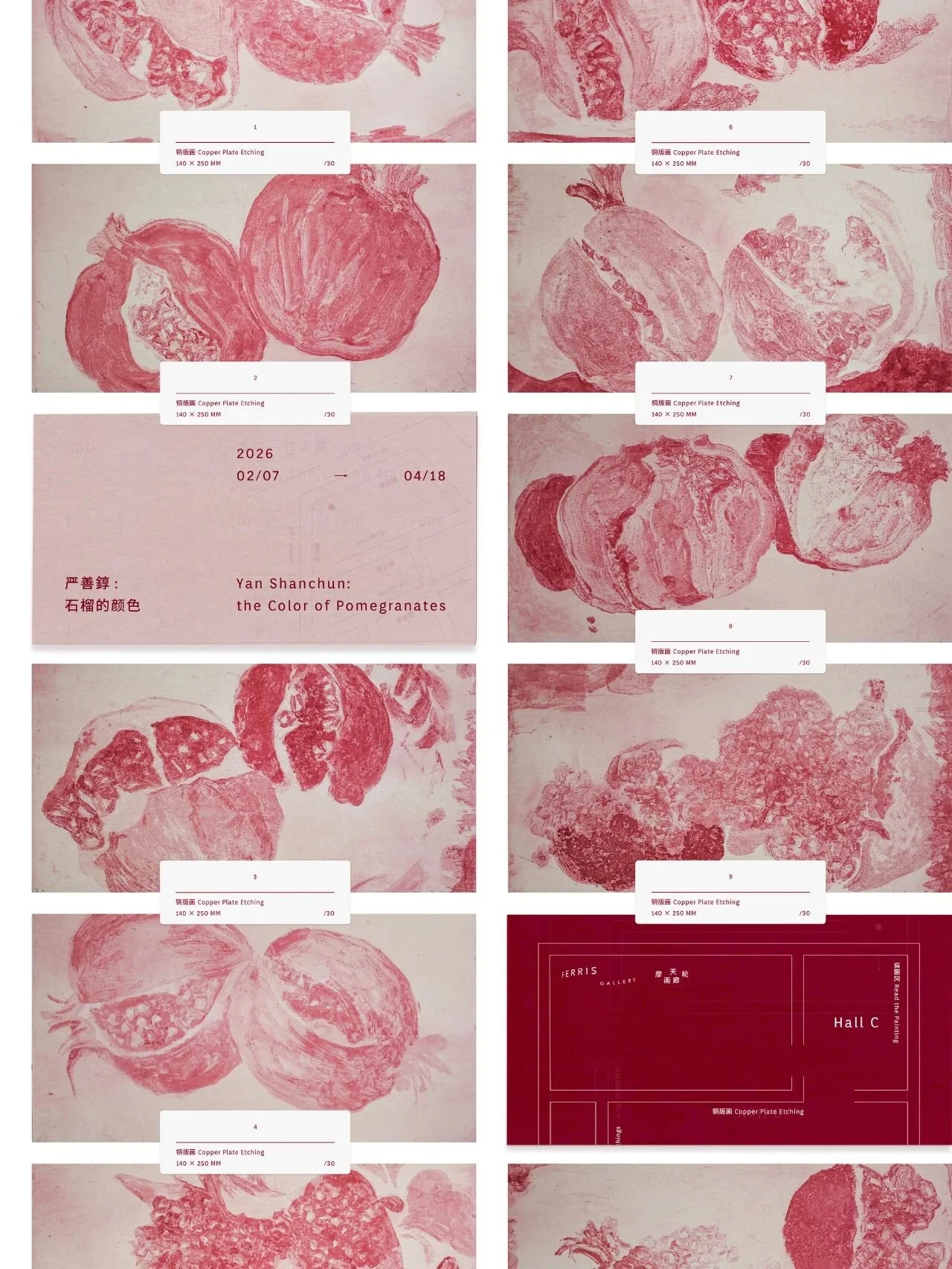
Pomegranates—symbols of abundance, prosperity, passion, and mystery. Since antiquity, people of deep feeling have endowed the pomegranate with layered meanings. It has become a key to emotion: whenever it appears, the door to metaphor quietly opens.
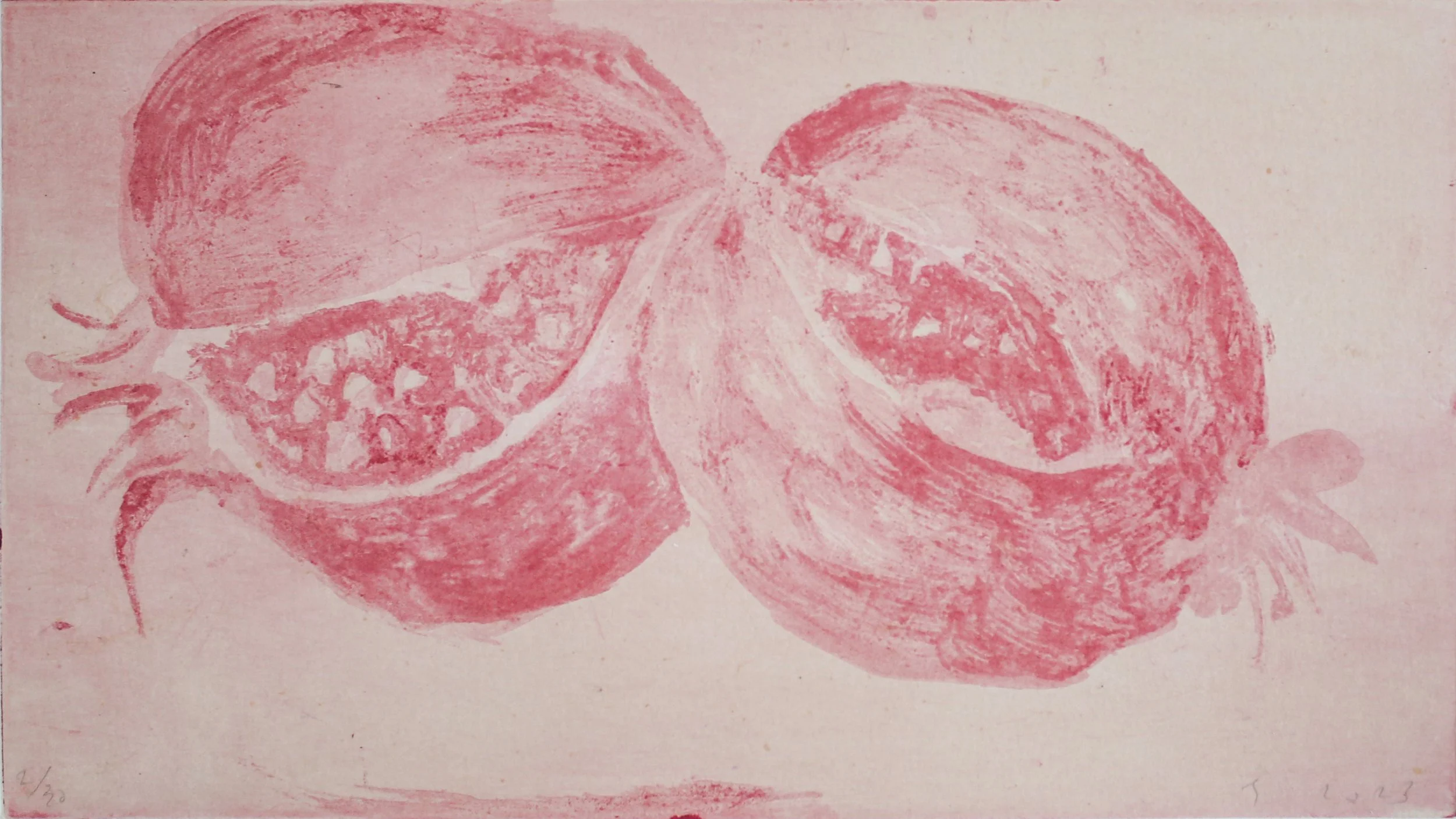
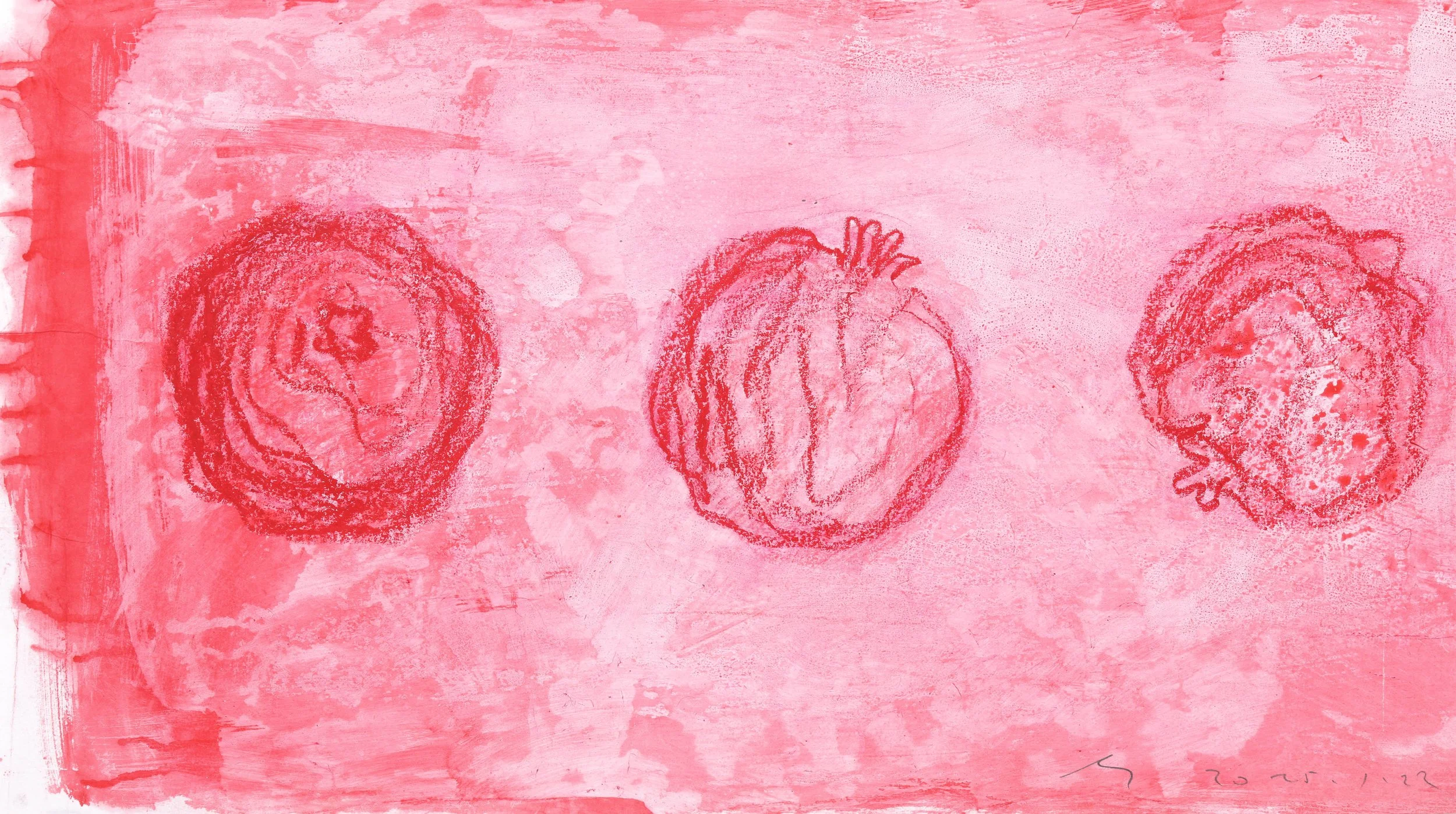
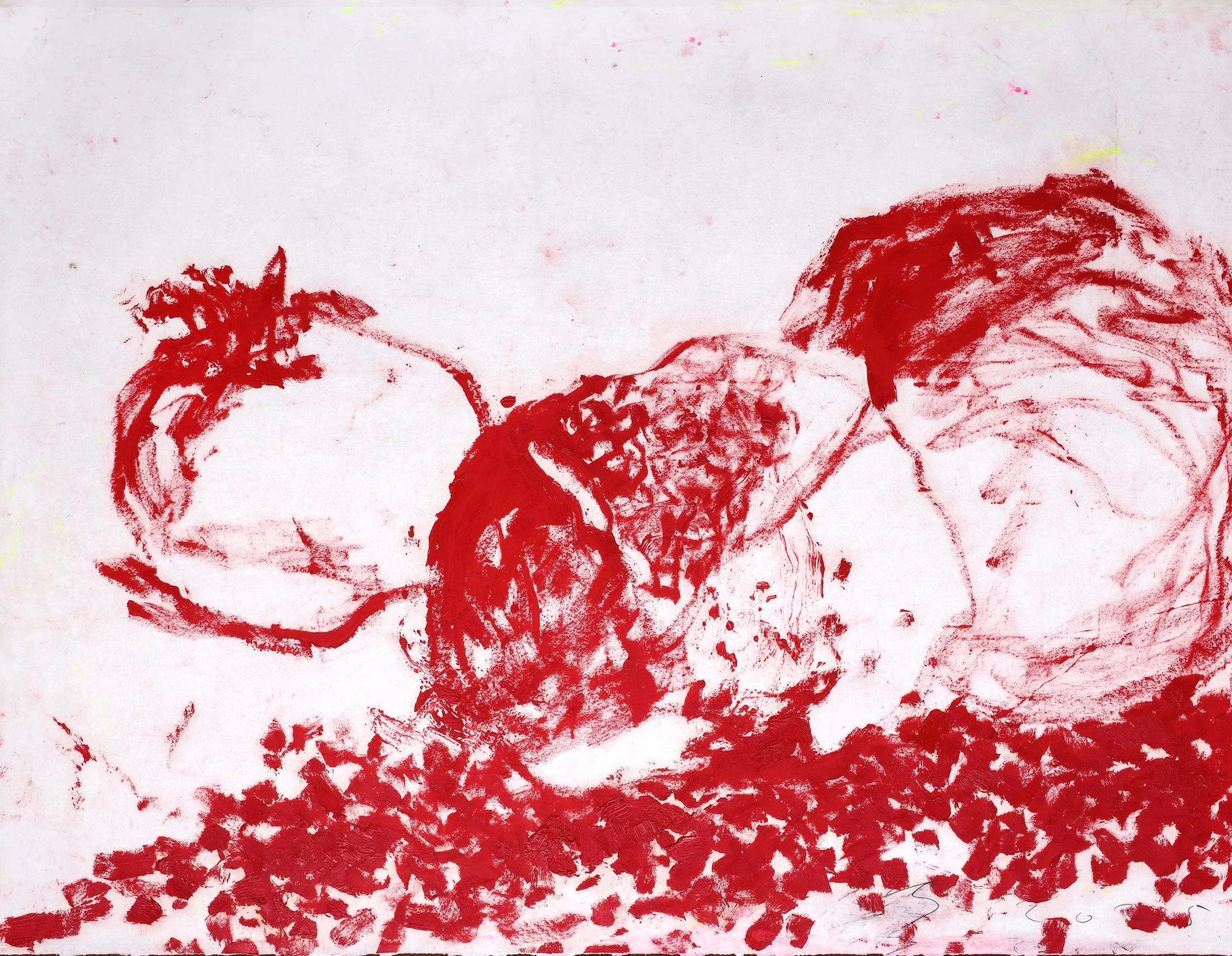
Yan Shanchun is a poet of remembered experience. His works require no ornate adjectives; before his images, we find ourselves alone with our most tranquil pasts—sometimes in motion, sometimes at rest; sometimes under rain, sometimes in clear weather. In Yan’s paintings, there is never scenery. What remains are the emotions and sensations one cannot bear to erase. Thus, when Yan Shanchun encounters the pomegranate, an entirely new experience is born—one that concerns the flow of the artist’s self-awareness and aesthetic intention.The Color of Pomegranates arrives as a genuine surprise. Yan Shanchun has rarely devoted his practice to the depiction of “objects,” yet in this series he turns his gaze toward the pomegranate: full and bursting, vivid and somber, still and splashing. Undeniably, they are pomegranates, bearing the form of the fruit—yet they are never merely pomegranates.
When speaking of Yan Shanchun, West Lake is inseparable from him. The gentle, enduring sensibility of Jiangnan flows languidly across gampi paper as thin as cicada wings; the scent of grass after rain and the faint chill of the lake breeze spill freely across the canvas. Having grown up by West Lake, Yan has long projected the emotions it bestowed upon him into his brush, roaming joyfully through the landscapes of Jiangnan in a spirit of unrestrained lyricism.Now, he pauses once more at the lakeside, resting briefly, savoring a cup of fragrant tea, and turning a pomegranate over in his hands. Yan Shanchun possesses a strong sense of self-awareness in his artistic practice. From the first spark of inspiration to the completion of a work, the act of “handling” or “playing with” an object is central to his process—and to the pleasure of creation itself. His motivation for painting is neither to surpass himself nor to rupture tradition, but simply to please himself. When the artist paints with joy, the viewer, too, may share in a state of ease and delight. The pomegranate thus becomes a fitting metaphor for this act of “handling.”
As a cultivated object placed upon the scholar’s desk—an item through which literati projected their sentiments—the pomegranate has traveled from the Tang and Song dynasties through the Ming and Qing and into the present day. With its many seeds, it resembles a fragment of history, carrying both the dust of time and the glimmer of aesthetic continuity. It has evolved into a spiritual vessel, containing humanity’s myths, imaginations, and cultural narratives. From this vessel, Yan Shanchun extracts the most vital image and integrates it into his own work: a fullness of life force.
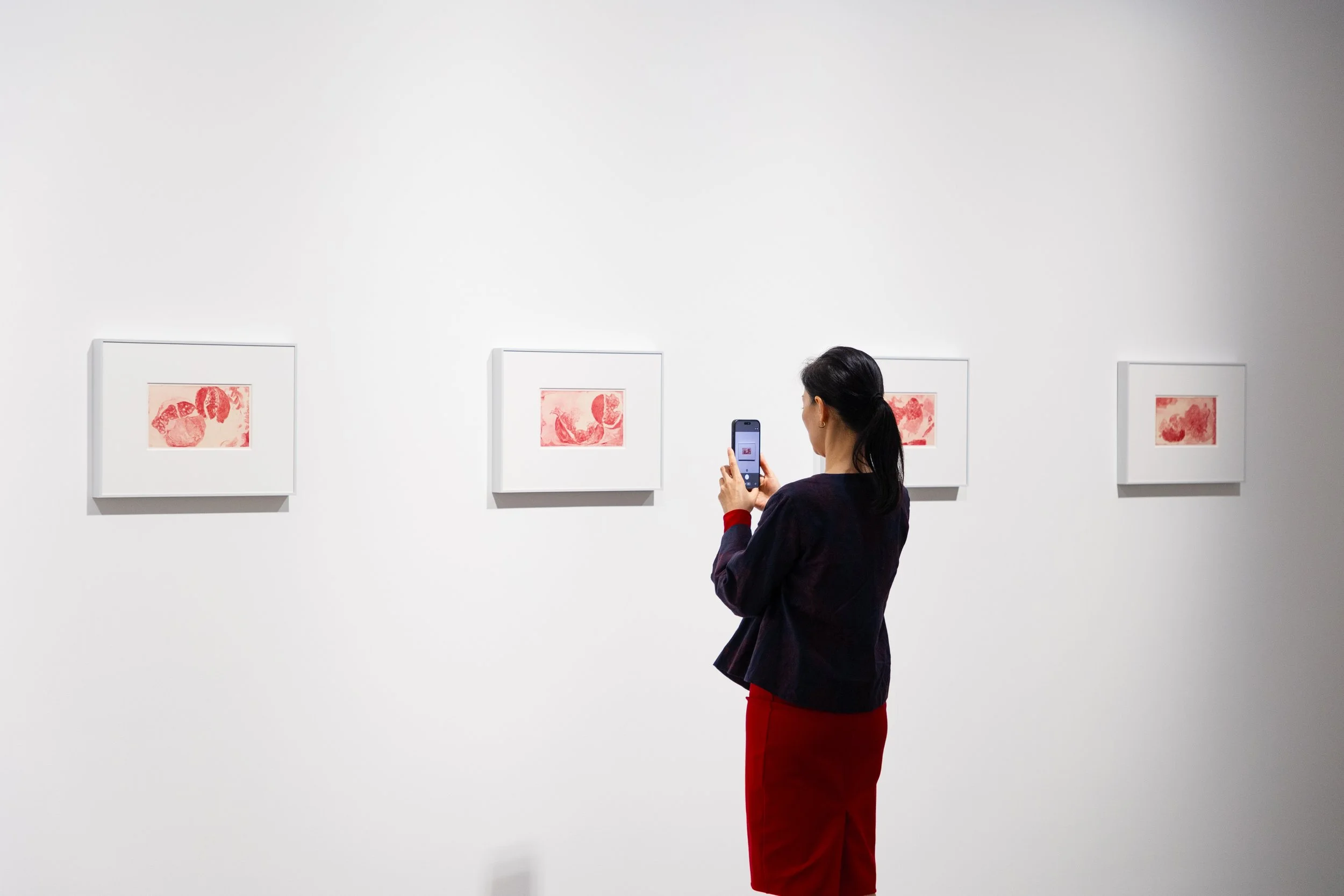
Across The Color of Pomegranates, each pair of fruits moves from vivid plenitude to explosive rupture. They take root and are reborn upon copper plates, germinate and bear fruit on gampi paper. Through the image of the pomegranate, Yan Shanchun channels the literati temperament within his practice toward a poetic vision of life, refining a composure that is at once worldly and transcendent.Yan Shanchun’s pomegranates are not repetitions, but reactivations of the pomegranate as an iconographic motif, transforming it into a spiritual image re-perceived through personal experience. His engagement with the pomegranate began as early as 2012, unfolding intermittently over more than a decade before reaching a form he found complete and satisfying. The initial impulse came from Xu Wei’s Pomegranate①, in which the literati spirit embedded within brush and ink planted the seed of the pomegranate in Yan’s mind. He began practicing the motif almost playfully; at this stage, the idea of the pomegranate took shape within him.A second encounter occurred with Albrecht Dürer’s Portrait of Emperor Maximilian I②. To convey the ideal of an enduring empire within the image of an emperor, Dürer chose a split-open pomegranate. Yan Shanchun, initially focused on painterly technique, found his earlier creative emotions rekindled by the fruit; its form began to germinate anew in his imagination.
The final catalyst was the Armenian film The Color of Pomegranates③. With its highly symbolic imagery and non-linear narrative, the film subverts conventional viewing habits. For Yan Shanchun, this experimental approach acted as a fuse, igniting and consolidating his long-standing passion for the pomegranate. He thus formally embarked on the series and named it The Color of Pomegranates.
The color of the pomegranate will eventually recede from its flame-like intensity. When we touch a dried pomegranate, it is as though we are caressing bare earth; when we crush a desiccated fruit, it feels like gently holding a handful of sand. In that moment, we recall its once-dazzling red—a fleeting, fluttering glimpse within the passage of time.
by Noam Zhang
Notes① Pomegranate, Xu Wei (1521–1593), Ming dynasty, ink on paper, 91.4 × 21.5 cm. Collection of the National Palace Museum, Taipei,China.② Portrait of Emperor Maximilian I, Albrecht Dürer, 1519, oil on panel, 74 × 61.5 cm. Collection of the Kunsthistorisches Museum, Vienna.③ The Color of Pomegranates, directed by Sergei Parajanov, released in 1969. Inspired by the life of the 18th-century Armenian poet Sayat Nova, the film is not a traditional biopic but an exploration of the poet’s spiritual world through highly symbolic, ritualized, and poetic imagery.Postscript
Color is never neutral; every hue carries its own tone and its own story.
Once, in Yan’s studio, he took out his father’s stamp album—a cherished possession. Although Yan himself never collected stamps, he could recall each one with ease. Some images marked his earliest encounters with art; others represented his first exposure to printmaking. Those familiar with Yan’s copperplate prints will recognize several recurring colors—deep reds, earthy yellows, and pale blues. Traces of these hues seem to appear in his stamp album as well reds, yellows, blues. They differentiate the distances a single image can travel within the confined frame of a stamp. In Yan’s work, different colors articulate distinct aesthetic possibilities within the same composition, conveying the languid sensibility of Jiangnan as he perceives it, while tinting the work with his own tone and narrative.
Before the exhibition, I visited Yan’s studio again. When we spoke of The Color of Pomegranates, he said that he wanted the work to possess a sense of vitality, which is why he chose this particular color; other colors felt incorrect, lacking a certain meditative quality. What, then, is this “vitality”? Later, I came to feel that it might be a form of mental animation—whether newly emerging thoughts or those responding to the past. They leap within the artist’s perception, absorb color, then leap again into the viewer’s perception, rising higher and higher like a spark until they land before our eyes.
Yan remarked that The Color of Pomegranates will continue. Perhaps this is because colors imbued with vitality have no real end.
by Noam Zhang